The Natural Approach For Managing Asthma (continued)

Early supplementation DOES make a difference.
Researchers in Sweden studied the association between multivitamin supplementation and allergic disease in 2,423 8-year-old children. They found that children who started taking multivitamins before the age 4 experienced the lowest incidence of either asthma or allergies.
[14]
There used to be controversy about when to introduce solid foods to infants, and which foods are likely to contribute to developing allergies later in life. A new review of 3 recent European studies indicates that delaying the introduction of solid foods beyond 6 months provided no additional protection against developing asthma or allergies by the age of 6 years.
[15]
In reality, food allergies were found to be more frequent in children who were introduced to solids later on in their lives. So, starting them on solid food around 6 months also appears to be protective.
The “Hygiene Hypothesis”
Initially, scientists blamed increasing air pollution for the surge in respiratory disease.
In the late 1990s, Dr. Erika Von Mutius, a health researcher, decided to compare the rates of allergies and asthma in East and West Germany.
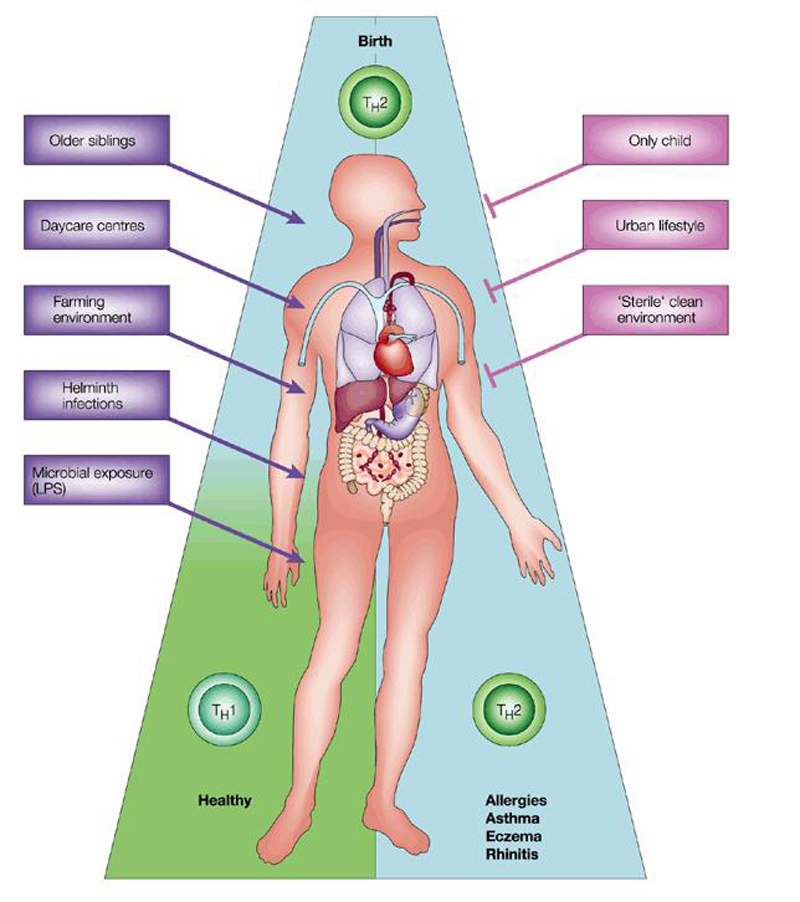 |
Her initial theory was that children growing up in the industrialized, polluted, and generally less healthful cities of East Germany would suffer from higher rates of asthma and allergies than the children who were raised in West Germany, with it’s cleaner and more modern environment.
Doesn’t that appear to make sense?
Well, when the two Germanys were finally reunified in 1999, von Mutius was finally able to compare their asthma rates.
What she found was exactly the opposite of her hypothesis.
Children raised in the polluted areas of East Germany actually had fewer cases of asthma and allergies than the more privileged children from the West.
[16]
While assessing the lifestyle differences between these two regions, what she found was that East Germans had larger families, and a much greater use of public daycare facilities.
This led her to develop a new “Hygiene Hypothesis”, which suggests that infants, raised around numerous other children and animals, are exposed to more microbial and viral challenges, and that this forces the infant immune system to create antibodies sooner, and that appears to be WHY their systems are more tolerant to the allergens commonly associated with asthma and allergies in the child's later years.
[17]
Since then, numerous other studies have demonstrated that reducing infant exposure to common infections during the first year of life significantly increases their odds for developing asthma
[18],
atopic allergies (those affecting the nose, eyes, skin, and lungs)
[19],
[20],
and lymphoblastic leukemia.
[21]
The following passages were culled from various prestigious medical journals.
All these studies conclude with very dramatic statements, such as:
“Exposure of young children to older children at home, or to other children at day care, protects them against the development of asthma and frequent wheezing later in childhood.”
[22]
“Our findings suggest that exposure to antibiotics and to infections in utero is a potentially important risk factor in the development of allergic disease.”
[23]
“These results support the hypothesis that reduced exposure to infection in the first few months of life increases the risk of developing acute lymphoblastic leukemia.”
[24]
As a chiropractor, I would be remiss if I didn’t also mention that the sympathetic nerve supply of the lungs arises from the upper thoracic (or upper back) nerves. This region of the spine houses our sympathetic nervous system, and when those nerves are irritated, they will produce contraction of the smooth muscles within the lung, leading to bronchospasm.
Chiropractic care to this spinal region has also been reported to be supportive in reducing the symptoms of asthma, and has also been shown to reduce patient reliance on corticosteroid inhalant sprays, especially when coupled with magnesium supplementation.
[25],
[26]
Go to Page 3
|
|
|